How does an AirTag actually work?
An AirTag has no GPS. It sends out a Bluetooth signal that nearby Apple devices in the Find My network pick up and relay as an approximate location. You need an iPhone to set it up and to see it. It runs on a replaceable CR2032 battery that lasts about a year. Apple positions it for things, not animals.
Because its location depends on how many Apple devices are nearby, in a quiet area or the countryside where there are few iPhones, the location may not refresh for a long time. Precise, directional finding only kicks in once you're already close to it.
On its AirTag page Apple lists keys, bags, a backpack and a bike, not dogs and cats. That's a fairly clear signal that this is an item tracker, not a collar tag for a pet.
What won't an AirTag do when a pet goes missing?
It won't show the finder your number directly. When someone finds your pet and taps their phone to the AirTag, a page opens with the serial number and the last four digits of your phone number. They only see full contact details if you've turned on Lost Mode beforehand and added a message. That's an extra step that's easy to forget.
The live location view is for you, not the finder. Someone without an iPhone or Apple account won't see where the pet is. On top of that there's a battery that will eventually run down and needs replacing.
An AirTag can help you narrow down where something is when Apple devices are nearby. But “someone found my dog and wants to call me” is a completely different scenario from “where is my AirTag right now”.
What works better for identification?
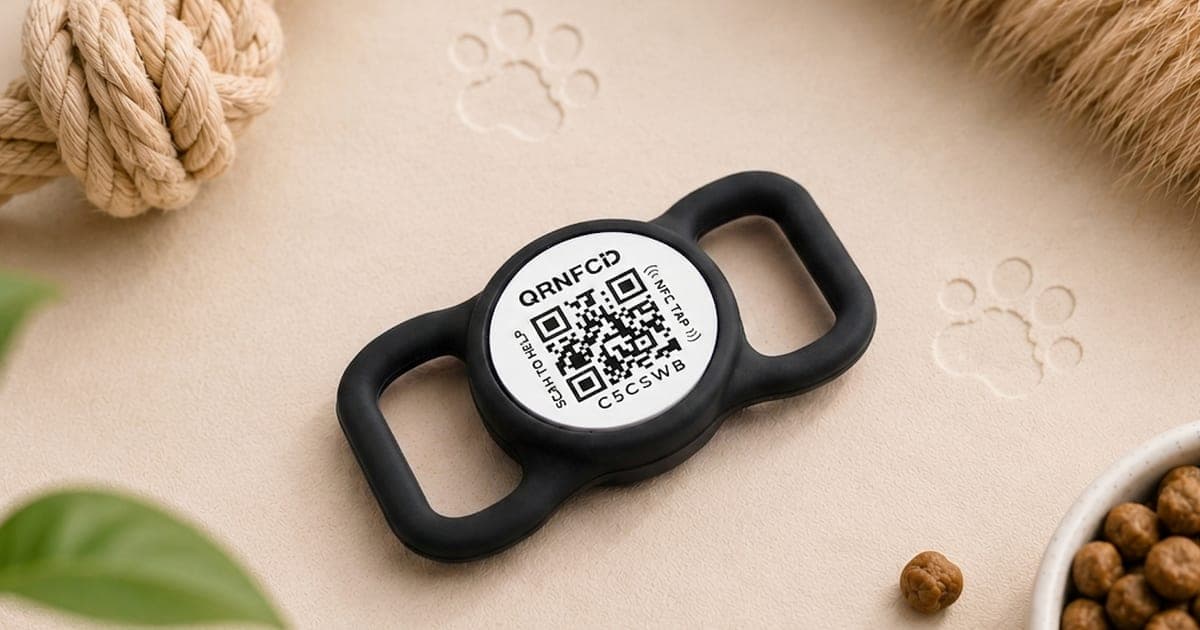
For getting a finder to call you straight away, a QR or NFC tag is simpler and more reliable. It has no battery, any phone can read it (not just Apple), and once scanned it shows the contact details you chose, with no emergency mode. The finder calls within seconds.
This isn't an either-or. If you want a rough sense of where your dog tends to roam around town, an AirTag can be an add-on. But the core, quick contact for a finder, is best built on a tag that works everywhere, every time.
If you're comparing ways to identify your pet, see our piece on the difference between a QR tag and a microchip, and the guide on what to put on the tag.